
Trusted Human Simulation: A Standard for Assessing Digital Twins
How to design, measure, and trust simulations of human respondents.
Abstract
The market for synthetic survey respondents is loud with accuracy claims and quiet on the question that actually governs adoption: can a buyer trust a given output enough to act on it, and to defend that decision to a stakeholder?
We argue that trustworthiness is as much a property of the infrastructure around a simulation as of the model itself. The paper sets out four pillars a trustworthy system must contain: Grounding, Simulation, Explainability, Validation, a measurement suite for fidelity, and the infrastructure that turns a raw dataset into guarded, auditable output.
1. Why trust is the bottleneck
Simulated respondents are the natural answer to rising panel fraud, falling response rates, and the demand for faster insight. Yet adoption lags. The problem isn't that simulations are inaccurate, it's that buyers can't tell when to believe them. An output arrives with no audit trail, no statement of its own reliability, and no test on the buyer's own data that could prove it wrong.
Can I trust this output, on this dataset, for this question, before I act?
The paper also draws a line the market tends to blur, between statistical boosting, generic LLM personas, persona-bots, and individually-grounded twins: one model per real respondent. It's that last form, we argue, where decision-grade value actually sits.
2. The four pillars: designing for trust
What separates a plausible twin from a usable one isn't model quality, it's the system around it. The paper specifies four pillars:
- Grounding: One record per real respondent, quality-screened before any simulation.
- Simulation: Reproducing the structure of real responses, marginals and the correlations key-driver work depends on.
- Explainability: Every answer carries the variables that drove it and an a-priori confidence score, locked in before any ground truth is seen.
- Validation: Reliability proven by a blinded, held-out test on the client's own data, never a vendor benchmark.
The paper's core argument is that these pillars constrain each other. You can't bolt any one of them on at the end.
3. Measurement: validation in depth
No single number can establish that a simulation is trustworthy. A simulation can match every distribution yet destroy the relationships between variables, or match the population yet fail a minority segment. The paper details a metric suite: distribution similarity, correlation preservation, and subgroup fidelity, and a blinded validation protocol run on data the client already holds and can re-check themselves.
It also makes a deliberately pointed case for why per-individual accuracy is the wrong score: research doesn't exist to predict one named person, but to estimate how a population is distributed. The unit of measurement has to match the unit of decision.
4. The infrastructure layer for trusted simulation
A better model can't, on its own, deliver trust. Trust is a property of the whole system. In practice, every question comes back not as a bare number but as a suite of measures: a distribution with uncertainty bands, a plain-language account of why, and a confidence score.
A system willing to say "do not trust me here" is what makes its high-confidence outputs credible.
5. Conclusion
The bottleneck for human simulation isn't accuracy, it's trust, and trust ensues from proper infrastructure. We propose this standard as the basis for assessing digital twins, and call for blinded, independent validation to become the norm.
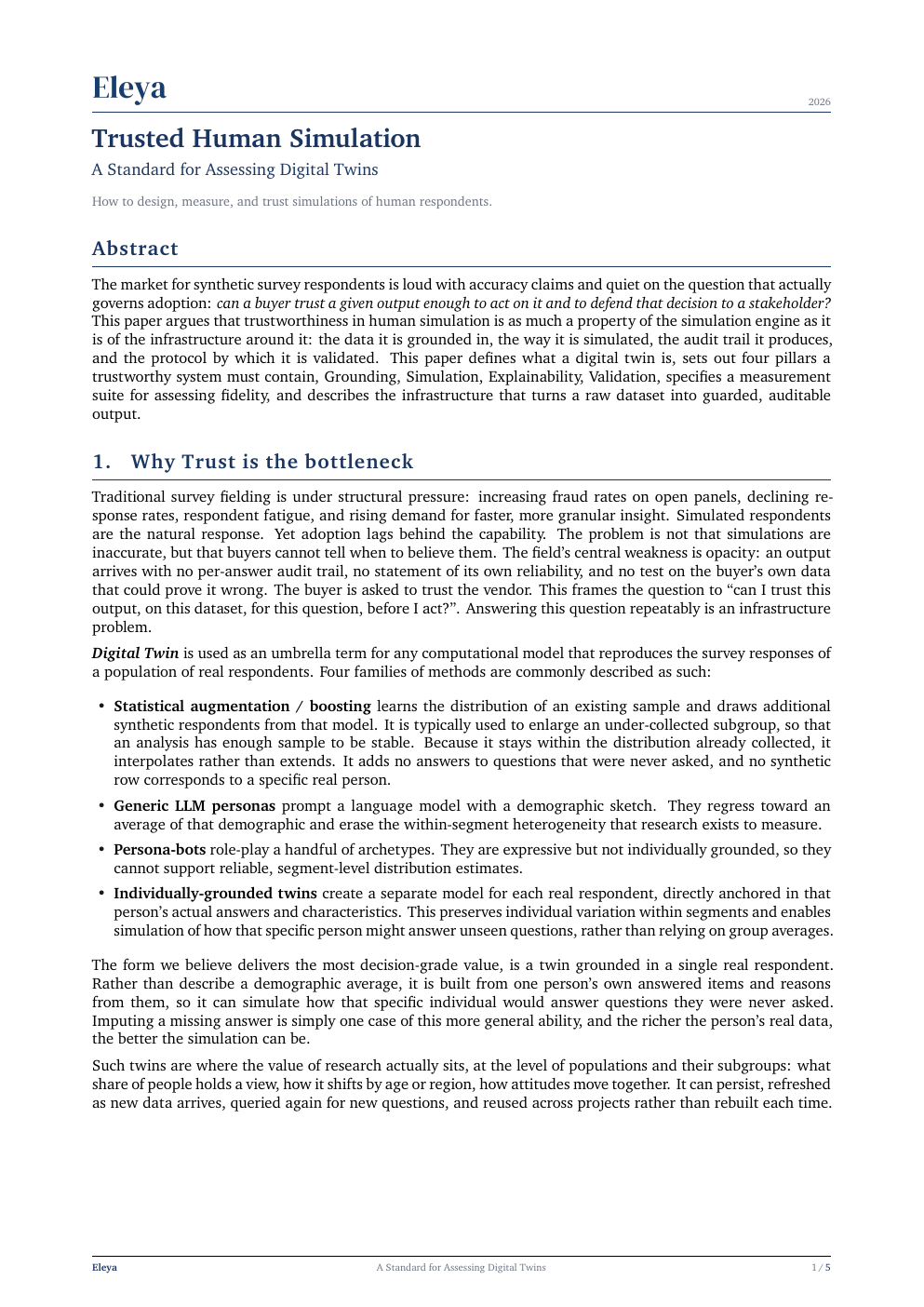
Read the white paper
Trusted Human Simulation: A Standard for Assessing Digital Twins
The full case: the four pillars, the metric suite (distribution similarity, correlation preservation, subgroup fidelity), and the validation protocol we think should become the industry norm. The PDF is attached. We'd genuinely like to be argued with.
The Eleya team